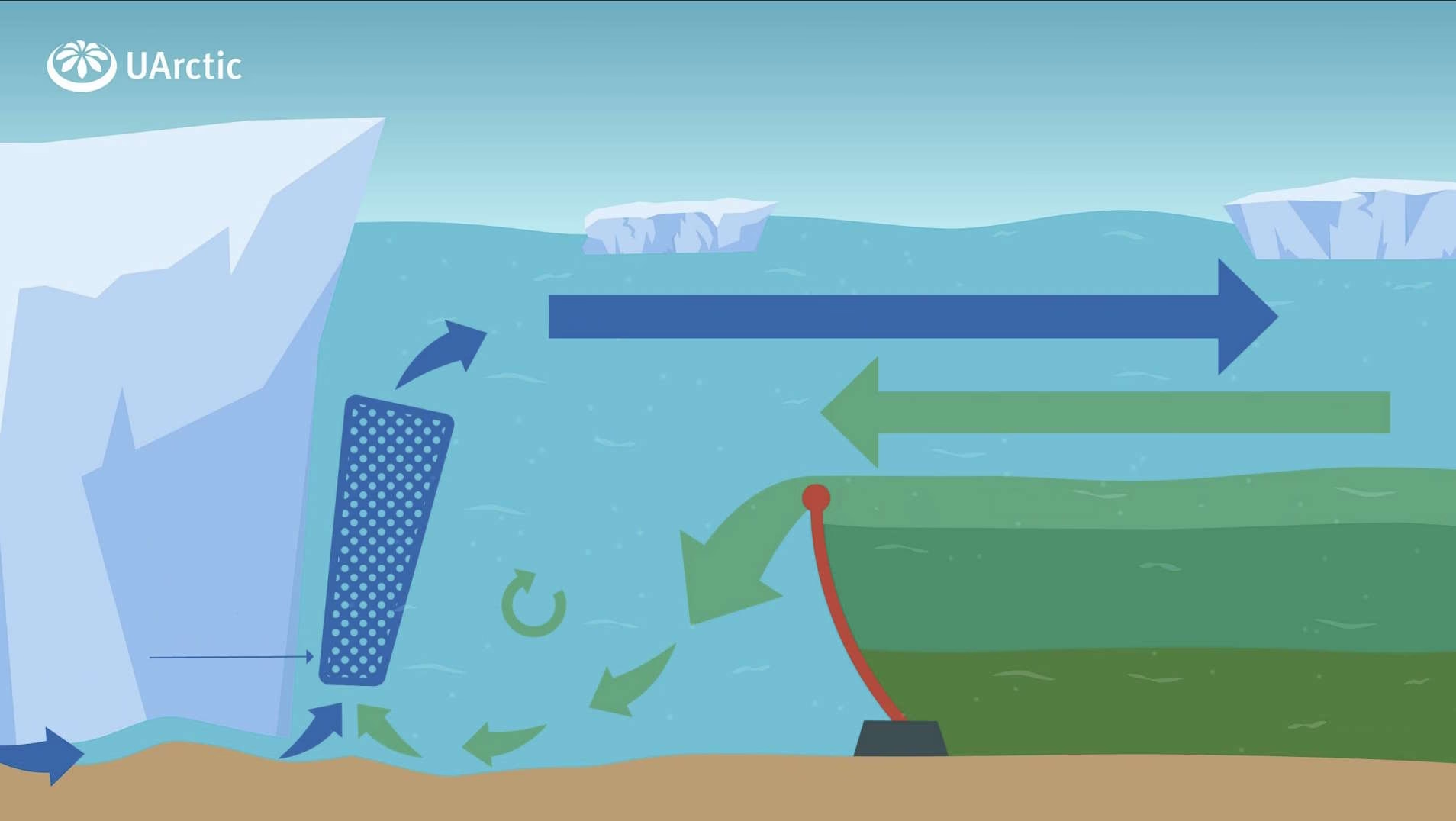
Our project is a non-profit, multi-national, and collaborative effort that brings together researchers and engineers from groups such as Cambridge University, University of Chicago, Alfred Wegener Institute, New York University, Dartmouth College, NIVA, Aker Solutions, and the University of Lapland’s Arctic Centre to engineer curtains that will redirect warm ocean currents away from the Thwaites Glacier, inhibiting widespread ice sheet collapse.
Project activities fall into three categories: science, technology, and governance.
Successful Deployment of Mooring Robots
Autonomous ocean moorings were deployed in the Pine Island Thwaites trough in the Amundsen Sea to collect long-term measurements of temperature, salinity, currents, and turbulence. These observations will provide the foundation for understanding how warm deep water reaches glacier fronts and drives melting beneath the ice shelves. The deployment was part of a KOPRI expedition to Antarctica in January – March 2026.
Natural Analogue Study in Svalbard
Akvaplan-niva is comparing two fjords in Svalbard. Warm-water inflow to Van Mijenfjord access is limited by a submarine sill which mimics the long-term effects of a seabed curtain, while a neighboring fjord has no sill and so has warmer waters. By comparing ecosystems, circulation patterns, and biodiversity in these fjords, the project gains insight into the possible ecological impacts of potential seabed curtain deployments. A report is expected in September 2026.
3D Digital Twin of Amundsen Sea and Thwaites
We will develop a high-resolution 3D digital twin of the Amundsen Sea that combines existing ocean observations, glacier data, climate models, and artificial intelligence. The platform will simulate glacier-ocean interactions, improve sea-level rise projections, and test different intervention scenarios before any real-world deployment. A Digital Twin will transform fragmented predictions into actionable insight.
An Underwater Observatory
Establish a permanent underwater observatory with sensors, cameras, and monitoring systems to continuously observe ocean conditions near glaciers. The observatory will validate models, improve understanding of ice-ocean processes, and support safe engineering development. The observatory will be realized through international collaboration. Better forecasts mean better decisions for coastal societies worldwide. Read more: International Thwaites Station – Seabed Curtain Project
Engineering
Design flexible seabed-anchored curtain systems capable of operating in extreme polar environments. The engineering includes mooring systems, materials, durability assessments, hydrodynamic behavior, and installation methods adapted for deep-water Arctic and Antarctic conditions.
Tank Tests
Conduct controlled laboratory and tank experiments to study water flow, curtain stability, pressure loads, and current redirection. These tests help optimize design performance and identify technical challenges before open-water deployment.
Field Tests
Deploy prototype curtain systems in a Norwegian fjord to evaluate performance under real marine conditions. Field testing will assess installation procedures, structural behavior, monitoring systems, operational safety, and environmental interaction. A pilot require a FPIC by indigenous peoples in the area.
Pilot in Svalbard
Implement a larger Arctic pilot installation in Svalbard to test curtain technology at increased scale and complexity. The pilot will provide critical operational experience and long-term environmental monitoring data in realistic polar conditions.
Deployment Greenland
Prepare for potential future deployment near vulnerable outlet glaciers in Greenland – if and when Greenland authorities ask for them. This phase will integrate scientific evidence, engineering validation, environmental assessment, and international governance frameworks.
Deployment Thwaites
Evaluate the feasibility of a future deployment near Thwaites Glacier in West Antarctica as part of an internationally coordinated climate adaptation effort. Any future implementation would depend on strong scientific evidence, environmental safeguards, and international agreement.